
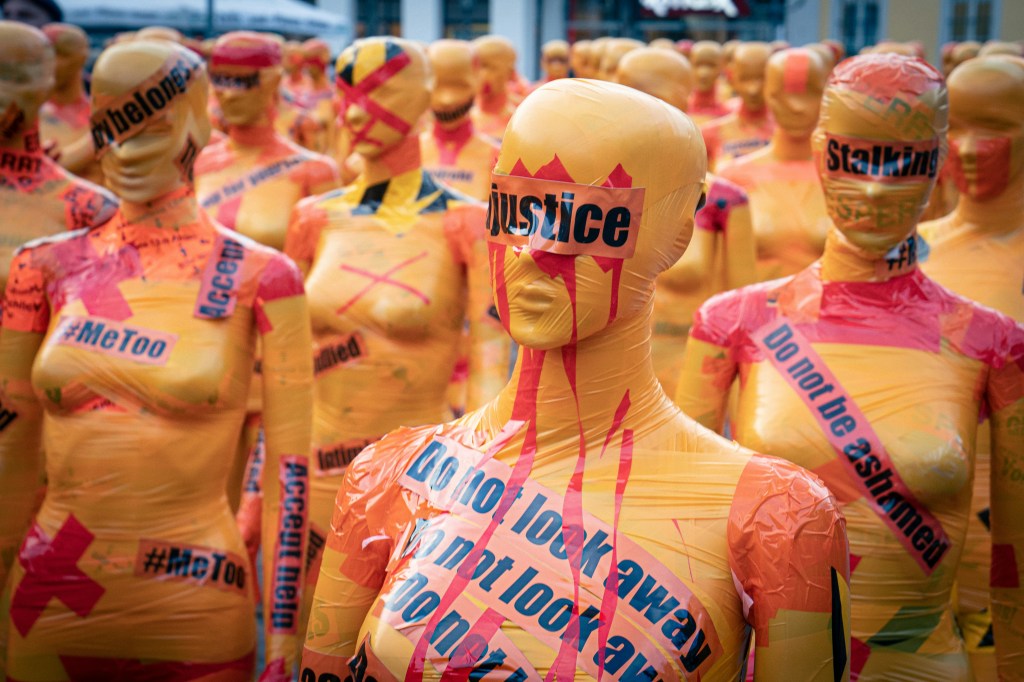
A reminder of what?
I was sitting on the terrace of a café, scrolling through TikTok, when I came across a reaction video to an interview. The guest, a man, said: “One or two slaps to my wife and she wakes up.”
He insisted he wasn’t a violent person. Just that women need a reminder of their place. And… I didn’t need to watch the whole video. I already knew what it was about.
There are moments when a news story, a testimony, or even a video on social media leaves us frozen. Because it shows, once again, how violence against women continues to be treated as something normal, as if it were just another opinion. It’s not a problem of one country or one culture: it happens in Peru, in Romania, on the internet.
Eyvi Agreda
In Peru, the case of Eyvi Ágreda in 2018 marked a before and after. A 22-year-old woman was doused with gasoline and set on fire on a Lima bus by a man who couldn’t accept her rejection. Eyvi survived for a few weeks but died from her injuries. Her femicide sparked mass protests under the cry “Ni Una Menos” (Not one more).
In 2023, Peru reported 146 femicides. According to the National Institute of Statistics, 35.6% of women aged 15–40 had suffered domestic violence in the previous year (2022, Government of Peru).
Teodora Marcu
In Romania, the murder of Teodora Marcu, a 23-year-old pregnant woman, happened in broad daylight, in front of her small daughter. She had already asked for help, had already requested a restraining order, but the institutions failed to protect her.
Her death sparked marches in Bucharest and other cities, with thousands demanding that femicide be recognized in the law and that authorities stop treating it as an isolated accident. In the first months of 2025, there have already been 25 femicides, while in 2024 there were 34.
42% of Romanian women have experienced physical and/or sexual violence since the age of 15 (2024, Gender Equality Index).
Tzanca Uraganu
And then there’s what circulates online. Recently, manele singer Tzanca Uraganu declared in an interview: “Îi mai dai o palmă, să o trezești” (“Sometimes you give her a slap, to wake her up”), referring to his partners. He said it smiling, and the production team just kept going, as if it were a casual remark.
Every minute on air without critical response becomes complicity. When a TV channel or a podcast allows a man to openly admit he hits women and lets it pass as a colorful comment, it contributes to normalizing violence.
Is silence complicity?
Violence against women is not a debate topic, nor just a point of view. We cannot remain silent. When we treat femicide, a threat, or a slap as just another opinion, what we do is legitimize violence.
I once heard a colleague comment on an acquaintance who was in an abusive relationship (verbal and physical). He said: “My opinion is that if she doesn’t leave, it must be because she likes it. How could anyone like that?”
I replied, in short, that violence involves many actors and that the responsibility doesn’t fall only on the person being abused but on the entire system. Unfortunately, the conversation went nowhere because he refused to accept that the problem wasn’t her, but the boyfriend.
That is violence. When we look at the abused person and question them, inventing reasons why they “deserved their bad luck”: she must have asked for it, maybe she enjoys it.
That is violence. When we justify the one who raised his voice or hand, abusing and mistreating the person in front of him: he was stressed, he had a bad relationship with his father, he suffered the same thing himself.
There is no reason that gives him the right to do it. And we don’t need to “understand” him either.
Our responsibility is to draw the line: to say no, to react, to make sure silence does not become complicity. Because every silence opens the door to the next blow.
Burned alive on a bus? Pregnant and murdered in front of her child? It horrifies me to read these stories. It horrifies me to know that this is what some men wake up thinking they should do.
It horrifies me even more that violence no longer outrages us. That we believe ratings, views, or likes are our new system of values.
If you know of a case of domestic violence, let’s talk.
 Ave Migratoria