
My tragic ambition 🍃💀
My first collection
I started my plant collection like anyone looking for some green company: choosing species that didn’t ask for too much. Not plastic ones, but ones that would bring life to my home—and that, if I forgot to water them, could survive my faulty memory. A bit delulu!
That’s how the first three arrived: a ficus, a snake plant, and a peace lily. Soon I’d be on the hunt for a fourth to complete the quartet.
Up until then, I was proud of spacing their watering ten to fifteen days apart. As long as they didn’t die, I figured I was doing a good job. Riiight?
Until the ficus leaves began to dry and fall, I discovered its location had to change: direct sunlight was burning it. Direct sunlight? But the sun didn’t even hit it directly… Anyway, I moved it to another corner.
Little by little, I found my favorite plant influencers, from whom I learned about propagation, reading the color of the leaves, and choosing the right soil. “Don’t panic,” I’d tell myself. Step by step. Even though three plants already felt like a big responsibility.
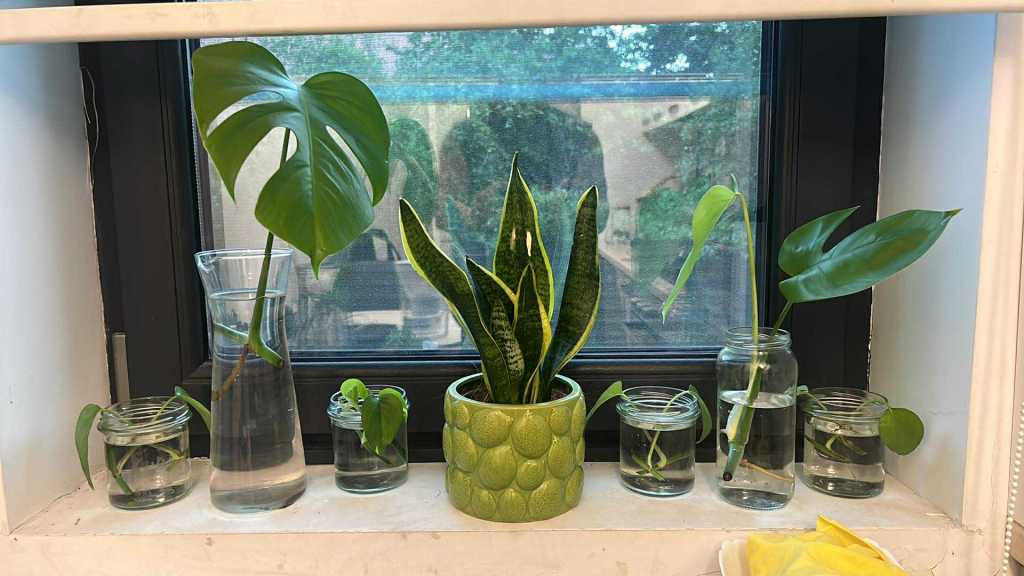
And as if that weren’t enough, I fell in love with two more: a monstera deliciosa and a pothos. My ambition took over and I wanted to propagate them right away. I placed half in the kitchen and the other half in my bedroom.
Then I thought my baby monsteras would be better on the balcony, with more light and air. Unfortunately, just a few hours without supervision was enough—it was too late. All their leaves ended up burned.

The rebirth
After that sad episode, I had to redeem myself. I looked up whether it was possible for the leaves to grow back using only the stem. I felt a bit like I was back in class, following instructions and taking notes. And, at the same time, I missed my parents’ garden.
I remembered those days when I loved to watch the roses. Around the buds, before they opened, tiny green insects would gather, unmoving unless I threatened them with my fingers. I don’t recall ever getting pricked by the thorns, but I do remember spending a long time observing them. Sometimes I’d be startled by the buzz of bumblebees, or amazed at how quickly hummingbirds darted away from my gaze.
Hoping I hadn’t burned them forever, I cut the stems, keeping the distance recommended by those “influencers” (and by influencers, I mean those plant experts who know the scientific names by heart).
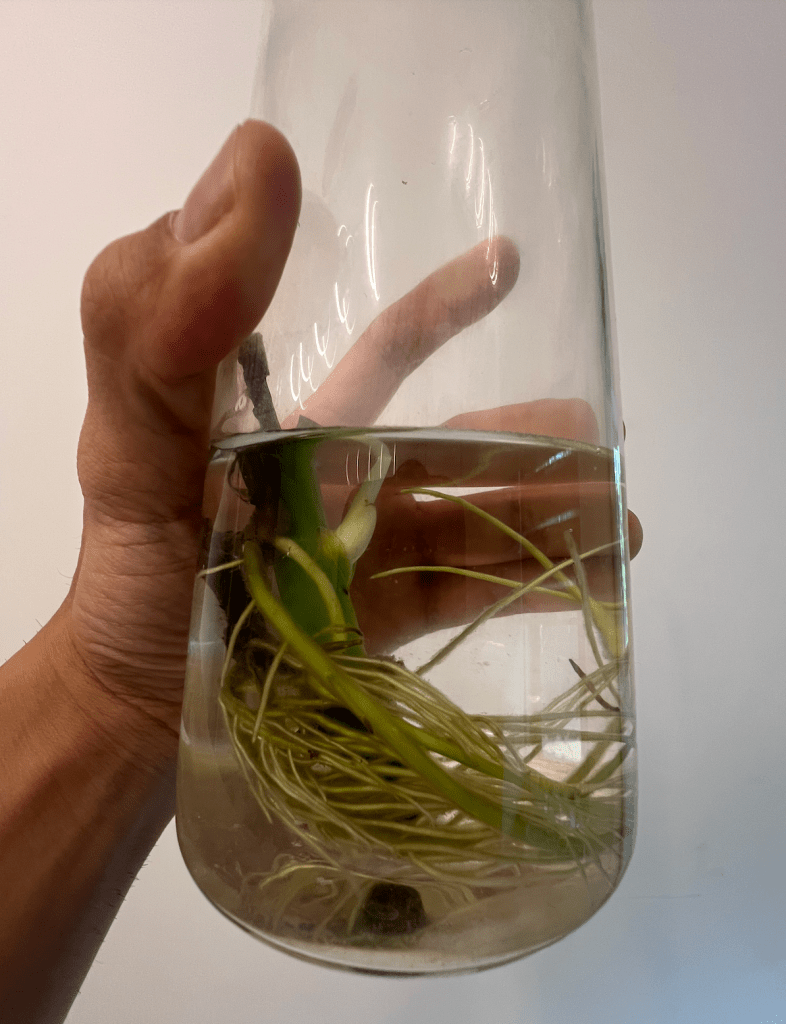
It’s been a couple of weeks now and, to my joy, I can say there are new shoots—a light, tender green. I’ve watched them from the first faint hint of color change to now, where they already look like little horns. Every two days I change the water because it starts to cloud, and I don’t like that. I don’t know if it’s the “right” thing to do, but if they keep growing, I must be doing something right… I think.
My horns
The rebirth of my plants makes me incredibly impatient. But when the changes become more visible, I feel proud.
It may sound cliché, but those childhood lessons about growth and change are true: plants need water, soil, and a long list of other things.
The truth is, it’s more complicated than that. Sometimes they don’t need that much water. There’s the location, humidity, air, light… and pests. An endless list.
What I really wanted to focus on was that moment when the leaves burned. And I think it stood out to me precisely because of my own recent experiences.
I’m often impatient for change. I seek it, I long for it. I work toward it and wait for it eagerly. Sometimes so much so, that in chasing more light and more air, I’ve ended up putting myself in the wrong place… and burning myself. Physically and mentally.
Not all is lost: there’s always a new opportunity to take a different path, change pace, or adopt new perspectives.
In some way, I identify with that monstera deliciosa. And not because of the “delicious” part, but because of the moment I realized my leaves had burned and I needed to act as soon as possible.
That part can be frustrating—when it feels like change isn’t coming and the more you watch yourself, the more it seems time has frozen. But in reality, underground, the roots are spreading and strengthening; the shoots are barely peeking out, but the process is happening. And soon, I’ll have my little “horns.”
I don’t actually want real horns, of course, but you know what I mean.
They’re those shoots I see in myself: slow to grow, but undeniably there. And they make me happy, because I know how much work they’ve taken to build. I’m making sure they’re in the right place now.
I hope you’re paying attention to your own leaves too.
 Ave Migratoria