
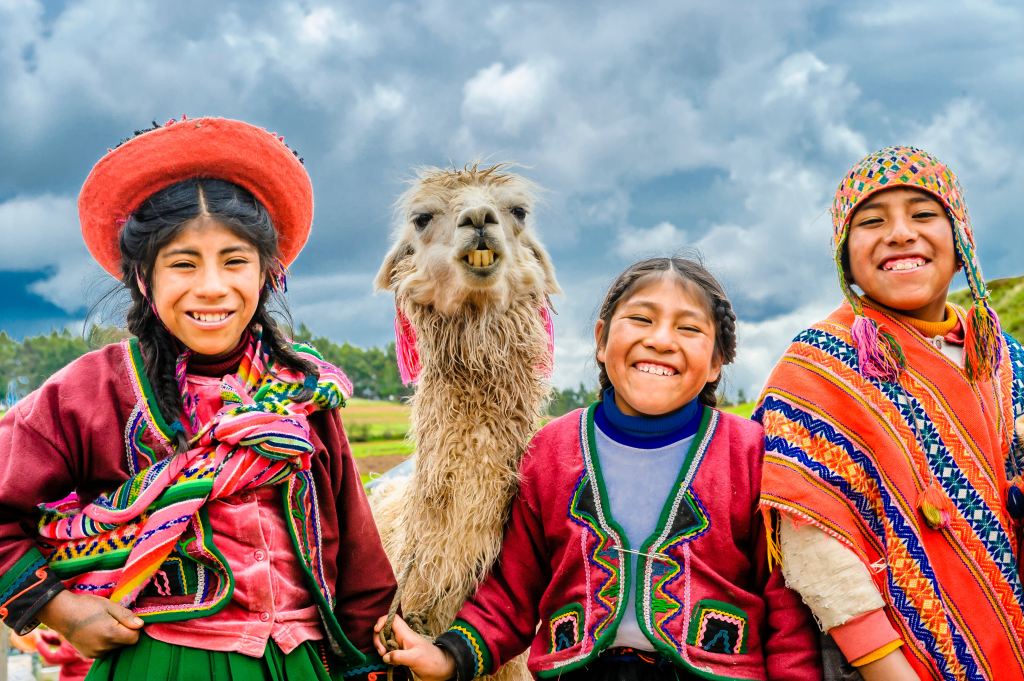
“How are you going to celebrate this month?” he asked me.
“This month?” I replied.
“It’s our month—July 28th.”
What a question! I’ve been disconnected from my country for a long time. And this year, more than any other, I feel it’s the right moment to remember where I come from.
While scrolling through TikTok, I came across the dance group Fredi’s Crew, led by Fredi Ghoul. The video I saw was actually a reply to a comment claiming they’d used AI. So I went to watch the original video.
Music: «Me tienes loca» by Grupo Ocobamba
Listen on Spotify here.
Lately, social media has been flooded with AI-generated videos, and sometimes it takes a moment to figure out what’s real and what’s not.
Two things in particular moved me: the dance and the music. I loved seeing Peruvians flooding the feed with their dances, their outfits with a modern twist, their talent and passion. And hearing a song in Spanish and Quechua filled me with nostalgia.
There are nearly 4 million Peruvians who speak Quechua as their mother tongue (it was officially recognized as an official language of Peru in 1975—you can read that in the online version of El Peruano).
Recently, I concluded that one of the ways I can further integrate not only into Romania but also into Europe is by learning German. Not easy—but fun. And it would be my sixth language (the others are Spanish, English, French, Portuguese, and Romanian).
When I hear the Quechua lyrics, I feel sad I can’t understand them, but I’m glad to recognize the sounds. And somehow, they make me want to dance. The combination of sounds helps me trace the instruments’ origins, and I’m transported back to my school days.
In high school, I joined the school orchestra as one of the violinists. I was very close to the peña (folk music ensemble) rehearsals. During university, I was part of the city’s youth and symphony orchestras. We also played traditional music.
When I reflect on my experience as a Peruvian in Romania, I describe it as a culture clash. The culture I wasn’t fully aware I had when I arrived, and the one I’ve adopted as I’ve integrated. And I say clash not in a negative sense, but as a set of moments that force me to see life, the world, relationships, and myself from perspectives I hadn’t considered before.
Recently, I met another Trujillano. What were the chances of meeting someone else from Trujillo in Bucharest? We went out for a beer. A beer? Me? In Peru, I used to drink only lemonade and coffee (we’ll talk about alcohol another day).
Our conversation turned into a cascade of memories—my old neighborhood, high school days, my routine at the French institute, my neighborhood in Lima (Pueblo Libre), and the area where my office was (Jesús María).
I’m still Peruvian—even if my Spanish accent has changed and I forget to use certain words in any of the languages I speak. That doesn’t make me a gringo (foreigner). It just makes me human.
I’ve never been ashamed to say I’m Peruvian. I’m not Spanish, nor Mexican. I say this because some people have told me “Mexico or Peru—it’s all the same.” And others are surprised I speak “clean Spanish” without ever having lived in Spain.
This month is a great opportunity to remember what happened on July 28th—especially for readers who don’t know the history of my country.
Our independence from Spanish rule was declared by an Argentine leader, General José de San Martín in 1821 after 300 years. The process was long and violent.
His most remembered quote:
“Peru is, from this moment, free and independent by the general will of the people and the justice of its cause which God defends.”
Since then, the country has gone through military coups, reforms, terrorism, corruption scandals, natural disasters, social unrest, and more.
Freedom and independence. When I think I’ve achieved them, I realize I’ve only climbed one step—out of hundreds still ahead. And I truly believe they depend on many factors outside our control. They are fragile. The news tells us that—if not everything, at least most of it.
But to answer the question of how I will celebrate, I’d say this:
I’ll celebrate by remembering and writing about what it means to feel free—free from oppression, slavery, or economic hardship.
I’ll celebrate that I have the freedom to learn, to read. To vote for a political representative.
To seek and choose a job. To dress how I want. To travel. To walk.
The freedom to sit for coffee wherever I wish and write about my stories.
And I’ll celebrate my freedom to say that this month, I dedicate my thoughts and prayers to those who still live in nations where freedom and independence do not yet exist.
Photo by Alexander Schimmeck, Unsplash.
 Ave Migratoria