
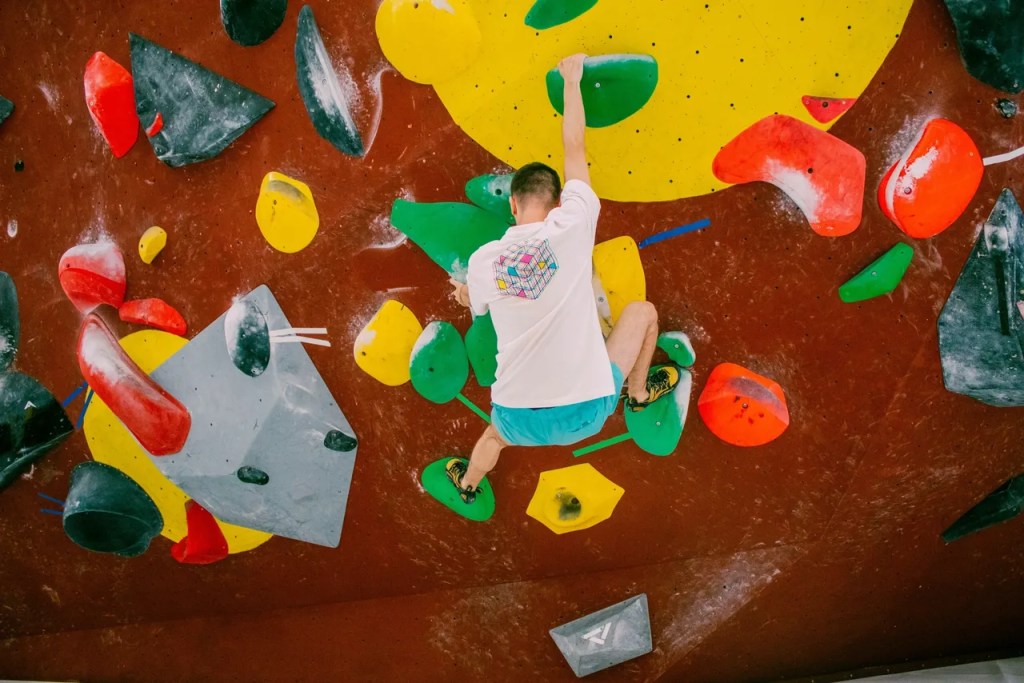
I reached the last foothold. With a mix of fear and boldness, I jumped to grab on. After touching it with both hands, I slipped but remained hanging by my left arm. My arm still hurts a little—my triceps, to be more precise. Like a pendulum, my body swung, turning my back to the climbing wall, and I simply let myself fall onto the mat—almost exactly as I used to do in gymnastics.
I started indoor climbing because a coworker was excited about finding a sport where he could see and feel progress in a more “tangible” way. One where his small frame and light weight were an advantage. And they truly are.
At first, I went a couple of times. Despite the intense joint pain in my arms, I decided to give the sport a chance. It vividly reminded me of my gymnastics years—being up high, jumping, hanging, the sound of the mat as I landed. The deep focus. The countless times you have to repeat a route before finally succeeding. The magnesium on my palms.
Three months, twice a week. Then I needed a two-month break. Now, I’m finally back. I have two climbing partners. With one, we talk about what it’s like to take up this sport in our late 30s. With the other, we talk about how successfully completing a route makes us feel like we’re Nadia Comaneci.
The indoor climbing I practice consists of climbing holds on an artificial wall that simulates rock climbing. The holds come in different shapes. The height can reach up to three meters. There are large mats to cushion falls. You need special climbing shoes (the internet tells me they’re called climbing slippers or cat feet in some languages). And magnesium for your hands. I’d recommend wearing pants because you’ll scrape your legs often. There are colors and levels. This is a general description.
It’s a sport that requires a lot of physical and mental effort. Focus is key. You start to realize how fun and interesting it is to see how your body finds balance in unusual positions. Your flexibility, height, and light weight will help you progress quickly.
I’m not tall, nor am I lightweight. I weigh 81kg! And flexibility? Well… I’m slowly getting it back.
I climb because it relaxes me. It makes my mind focus entirely on that one activity. I don’t think about anything else except the next hold. And the next. And the next.
It’s a sport where falling and failing are normal. You never feel good about falling for the thousandth time. It’s just as frustrating every time. But you know it’s necessary, and you accept it as normal. And that—that is a crucial lesson for everyday life as well.
Recently, I watched a national climbing competition. I saw the first part—the women’s event. I recognized one of the contestants. I remembered that she’s very small, light. Incredibly skilled and flexible. Always focused.
After attempting the fourth and final route without success, I saw her cry and hug her teammates.
It made me think: no matter how much you prepare, no matter how many times you’ve succeeded before, the frustration and pain of failure are real. There’s no need to hide it.
I really enjoyed watching her compete. Seeing her give it everything she had. And while I felt a little sad, I also felt joy knowing that she had familiar faces by her side, supporting her until the very end.
If you are in Bucharest, visit Natural High.
 Ave Migratoria